BatteryAging
Symbol | 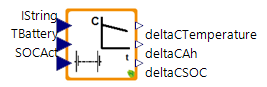 |
|---|
Use
This is a simple statistics-based battery aging component. It calculates the capacity degradation of electric batteries regarding internal chemical aging effects using mathematical and statistical approaches.
The model focuses on influences of battery temperature as well as battery use to model capacity degradation effects. It is an essential part of all Green City battery models, such as:
GreenCity.GreenBuilding.StationaryBattery.StationaryBattery
GreenCity.GreenBuilding.Vehicle.BEV
GreenCity.GreenBuilding.Vehicle.PHEV
GreenCity.StorageSystems.BatteryStorage
In these models, the user can activate the aging analyses by setting the parameter CalcAging to 'true'. In GreenCity.StorageSystems.BatteryStorage this setting is default.
Parameters and Connectors
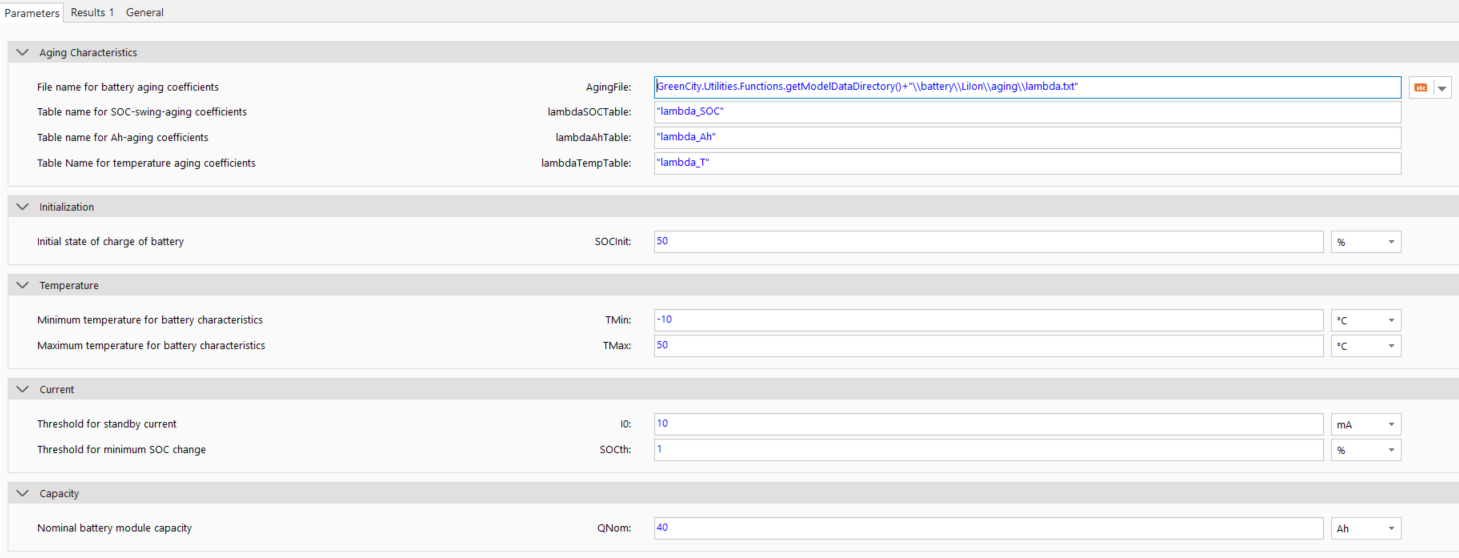
The battery aging model is actually designed as integral part of the Green City battery models. Parameters are typically defined with these models' default parameters. The following parameter set is basically available:
AgingFile: File & directory of input data sets describing general aging characteristics
lambdaSOCTable: Capacity degradation depending on battery cell cyclization (see Model Background)
lambdaAhTable: Capacity degradation depending on total amount of charge taken from the battery cell (see Model Background)
lambdaTempTable: Capacity degradation depending on battery cell temperature (see Model Background)
SOCInit:: Initial SoC of battery cell
TMin: Lower limit of described battery cell characteristics
TMax: Upper limit of described battery cell characteristics
I0: Current hysteresis - enable switch between charge & discharge
SOCth: SOC hysteresis - enable switch between charge & discharge
QNom: Nominal battery cell capacity
In case of customized analyses with this battery aging model (i.e. if not used as integral part of Green City battery models), the user needs to connect all available input ▶connectors with suitable model variables (e.g. via Modelica.Blocks.Source.RealExpression):
▶IString: Battery cell current
▶IBattery: Battery cell temperature
▶SOCAct: Battery cell state of charge
The model outputs are three (independent) capacity degradation values which are used to define the aging characteristic of the modeled batteries:
▶deltaCTemperature: Absolute capacity degradation depending on battery temperature
▶deltaCAh: Absolute capacity degradation depending on total amount of discharged energy
▶deltaCSOC: Absolute capacity degradation depending on total amount of charge/discharge cycles
Model Background
This battery aging model describes the capacity reduction of battery cells based on average statistical data. Various physical and chemical processes in the cells contribute independently of each other to a certain degree of damage to the battery over its lifespan. The end of battery life is defined as reaching a maximum battery capacity of 80% of the nominal state (SOH=80%).
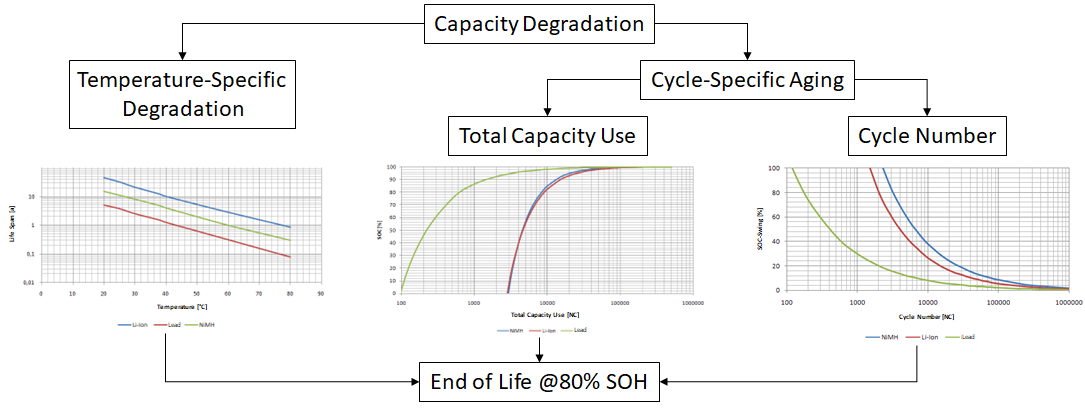
The temperature-specific degradation based on the fundamentals of normal chemical processes. The reaction rate usually doubles when the temperature increases by 10 K. Standard values for the lifespan of various battery cell types were taken from empirical data for the nominal temperature of 25 °C.
Cycle-dependent aging processes depend on the total capacity utilization and the total number of charging and discharging cycles that a battery cell must complete. Both effects can cause a certain amount of damage to the battery cells. They are therefore evaluated individually in the model. However, the two are linked, as they both describe the entire usage history of the battery cell. Again, base of all input characteristics are empirical data of various battery cell types.
Therefore, the total capacity degradation in Green City battery models is always described as the sum of the temperature-specific degradation and the maximum of both cycle-dependent aging processes.