HeatingSystem
Symbol | 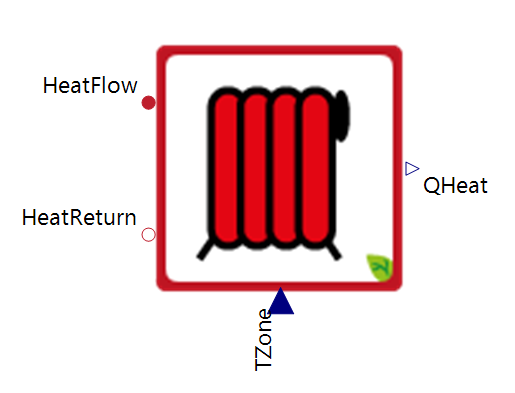 |
|---|
Use
The HeatingSystem component represents a thermal heating element that can transfer heat to a zone via convection or radiation. It characterizes the heat input of a building zone depending on flow, return, zone temperature and further heating system parameters. It could be used in combination with the Building Zone component.
The HeatingSystem component covers the following applications.
Basic: The HeatingSystem component outputs a heating power. No distinction is made between convection and radiation.
ConvRad: Here, in the HeatingSystem component, the output power is split between convection and radiation. This results in two power values that can be passed on to the corresponding zones.
Parameters and Connectors
Basic
In its basic version, the HeatingSystem uses a temperature input ▶TZone, which is used to regulate the HeatingSystem. The output of the zone temperature of the zone to be heated should be connected here. ▶HeatFlow is the flow of the radiator. This is where the heating fluid, including temperature and volume flow, is transferred to the model. ▶HeatReturn represents the return flow from the radiator. Here, the cooled fluid was returned to the storage system or heater. ▶QHeat represents the resulting heat output in the zone.
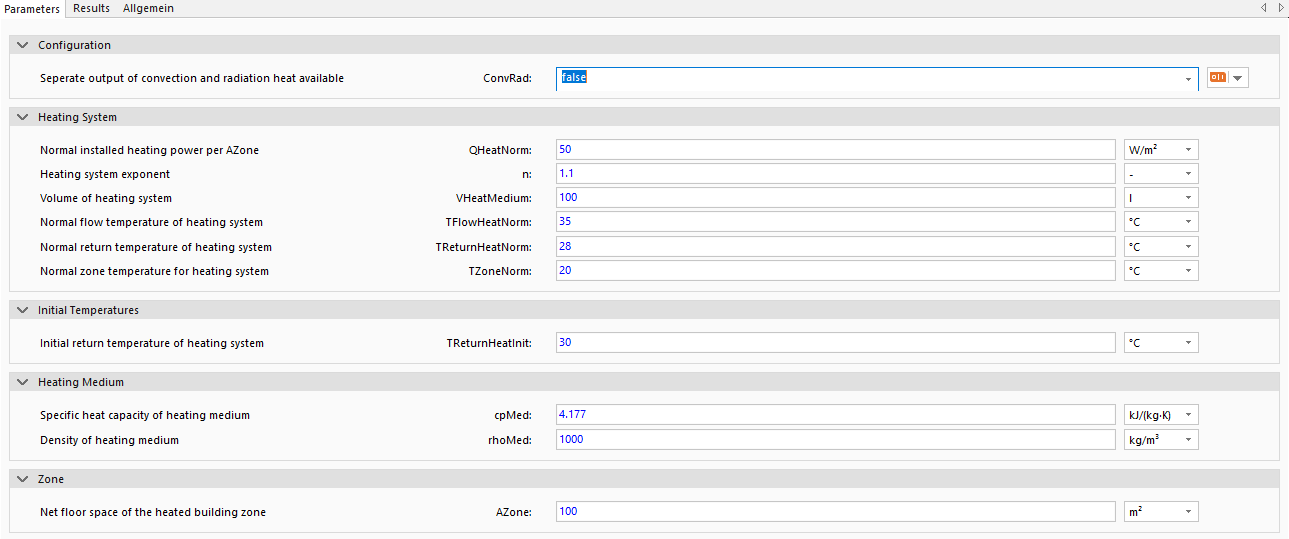
ConvRad is set to false in the basic case. For ConvRad case, set true. The installed normal heating power = QHeatNorm is defined as heat power per m2 net floor space area. Parameter values between 15 W/m2 and 300 W/m2 are valid. The heating system exponent n describes the nominal share between radiation and convection. It is highly dependent on geometrical heating system characteristics. The following parameter values can be used as a basic input set, if no further information is available.
n=1.00 .. 1.10: floor heating
n=1.20 .. 1.30: panel radiator
n=1.25: ribbed radiator
n=1.3:radiator
n=1.25 .. 1.45: convector
The heating medium's volume VHeatMedium is closely connected to system type and geometrical characteristics. A sufficient parameter definition is required to avoid numerical difficulties. Note if no further information is available, a heating medium volume of about 100 l to 150 l per 100 m2 net floor space area (equal to floor heating system) is feasible.
TFlowHeatNorm describes the nominal flow temperature of the heating system. TReturnHeatNorm describes the nominal return temperature of the heating system. TZoneNorm describes the nominal zone temperature.
TReturnHeatInit determine the start return temperature at the start of the simulation. This parameter is used for more precise control of the simulation initialization or the model calculations.
The parameters of the fluid are described by cpMed average specific heat capacity and rhoMed average density.
AZone describes the base area of the zone.
ConvRad
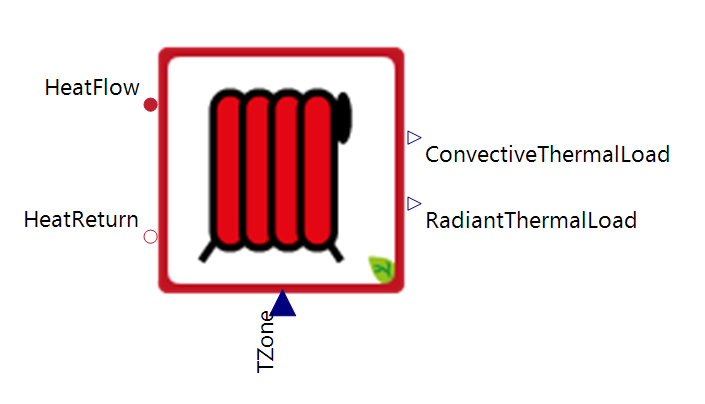
The user can additionally, define if the model output shall be the overall heat output (QHeat) or if this result should be divided into convection ▶ ConvectiveThermalLoad and radiation ▶ RadiantThermalLoad heating shares.
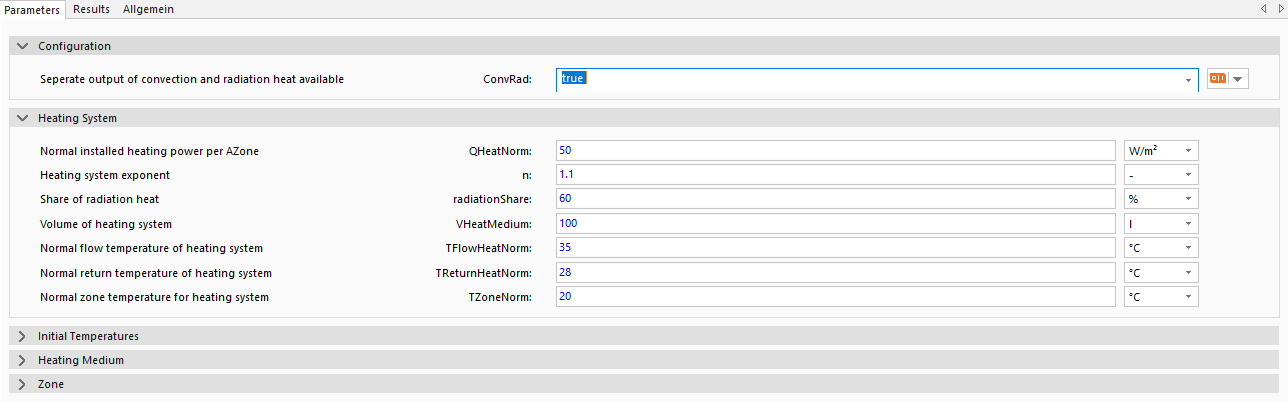
In such a case use the boolean configuration variable ConvRad. If this value is set to true, another parameter is made available namely, radiationShare. This parameter defines the constant share of heat radiation regarding the overall heat output. This value highly depends on geometrical system and building characteristics. If no further information is available, use following default values dependent on previously described characteristics.
ceiling heating:92%
wall heating: 69%
floor heating: 50% - 69%
panel radiators: 40% - 50%
ribbed radiators: 20% - 30%
convectors: 10%
Model Background
Info 1
The following heating system equation describes the implemented relations between simulated flow, return temperature, indoor temperature, parameterizable heating system characteristics, installed heating power and the building's heated surface area.
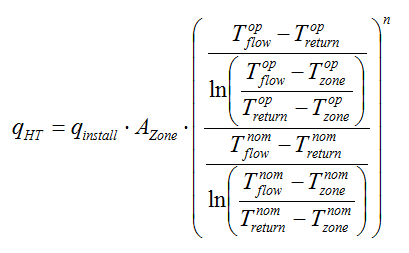
Info 2
To model unheated building zones use Modelica real expressions und define the constant heat power as 0 W.
Info 3
Always connect the corresponding indoor temperature output to the zone temperature input to avoid numerical difficulties.