ICEV
Internal Combustion Engine Vehicle
Symbol |  |
|---|
Use
The internal combustion engine vehicle (ICE) cannot be recharged at a decentralized charging station of a building. The energy and associated fuel demand of the vehicle are thus independently of the building energy system behavior and can therefore both be simulated separately.
Parameters and Connectors
Connectors
▶Present and ▶Drive have to be supplied to the vehicle model. If ▶Present is True, the vehicle is connected to the charging station. If ▶Present is False, ▶Drive has to be True because the vehicle is driving.
Note: You can easily define a presence or driving profile, for example depending on the HourOfDay and DayOfWeek by using the results of the environment model Environment.
Parameters
Vehicle dynamics and electricity demand
To simulate the fuel demand of the vehicle to travel a desired distance, a quasi-static approach is used. For this approach the drive-cycle specific average velocity vCycleAverage and fuel power demand PFuelCycleAverage are included in the vehicle model as constant parameters. It is thus assumed that the vehicle moves with a constant average velocity and fuel power demand. These two values could be calculated in more detail during pre-processing using dynamic simulation or quasi-static calculation approaches. This assumption also helps to reduce simulation time which is a main requirement in the model development.
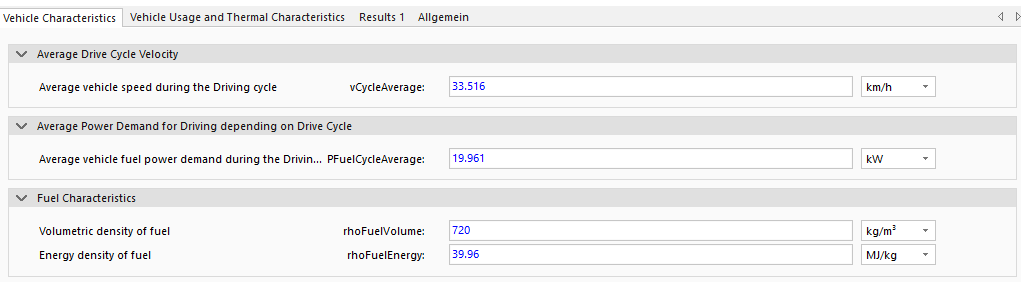
Applying such an approach, allows for the inclusion of detailed drive-cycle data for fuel power demand, into the simulation process without increasing model complexity and resultant simulation time. To ensure correct simulation the time-dependent characteristics for vehicle ▶Present ('true' when present) at charging station and ▶Drive ('true' when vehicle is driving) have to be supplied to the model. They determine the vehicle usage scenario.
Air conditioning and heating
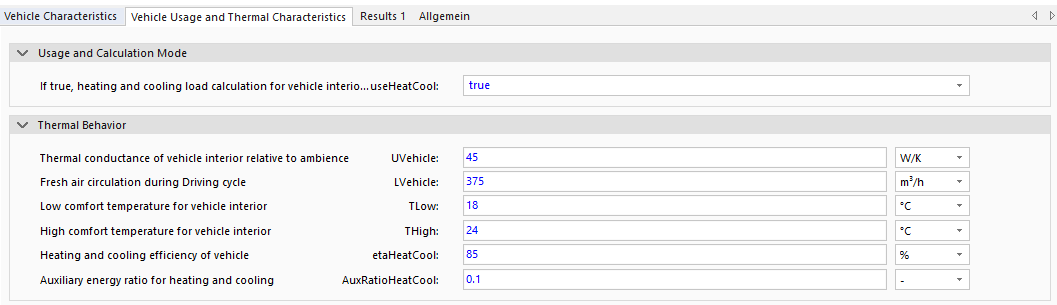
Besides the power demand for driving, interior air conditioning and heating are two of the most important influences on overall energy consumptions of vehicles. To consider this the vehicle cabin is modeled as thermal one-zone-model. Concretely, heat losses and gains through the shell via heat transmission (UVehicle) and ventilation (LVehicle) dependent on the ambient temperature, are considered and simulated. According to the temperature difference between low TLow and high THigh comfort temperatures the heating or cooling load is calculated.
In conventional vehicles thermal energy for heating and cooling can be provided using the heat losses of the ICE, external heating systems and air conditioning.
The model parameter AuxRatioHeatCool defines how much additional energy must be provided by the ICE to run the integrated heating and cooling systems with the corresponding system efficiency (etaHeatCool). As an example; if this factor is set to 0.1, 10% of demanded heating and cooling energy are additionally provided by the ICE (this is mostly to run the compressor of the air conditioning) and thus cause a higher fuel demand.
All other parameters that are not explained should only be adjusted if measured values are available. If no measured values are available, retain the default values.