GroundCollector
Symbol | 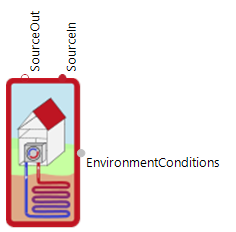 |
|---|
Use
The ground heat exchanger represents a brine-filled tube heat exchanger that is installed in the ground. It depicts both the heat exchangers and the affected ground. It can be used as heat source for the heat pump model or as cold source.
Parameters and Connectors
The ground heat exchanger maps the affected ground around the heat exchanger and the heat transfer from this to the heat transfer medium. The medium is connected via the ▶SourceOut and ▶SourceIn pipe connections. In order to map the floor not affected by, it is necessary to connect the ▶EnvironmentConditions. The parameters for the ground (cGround, rhoGround, lambdaGround and GeoGradient) set in the environment block are decisive here. The affected ground is adjacent to the unaffected ground and the heat exchangers.
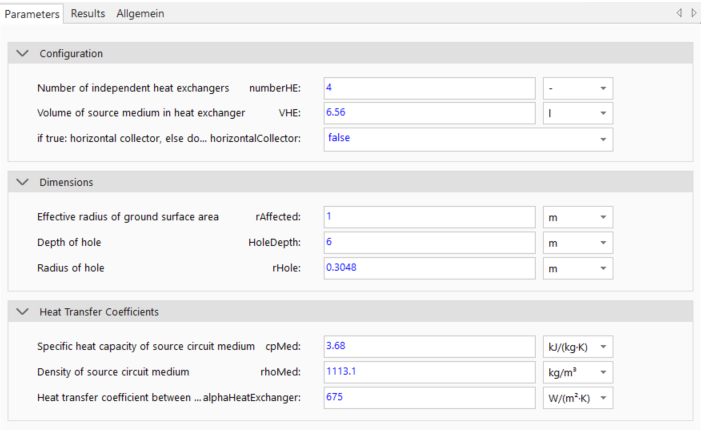
To characterize the GroundCollector, the radius of the affected ground around the HeatExchanger (rAffected) as well as the depth (HoleDepth) and the radius (rHole) of the HeatExchanger must be specified. In addition, must be specified whether it is a horizontal or vertical collector (horizontalCollector). For horizontal collectors, the rHole parameter is assumed to be the diameter of the collector field, while for vertical collectors it describes the pipe radius.
The system size can be defined using the number of HeatExhangers (numberHE) and the volume of the HeatExchangers (VHE). The heat transfer medium in the heat exchanger is characterized by the specific heat capacity cpMed and the density rhoMed. The transition between the medium and the affected ground is described using the parameter alphaHeatExchanger.
Model Background
Here is a figure to illustrate the parameters:
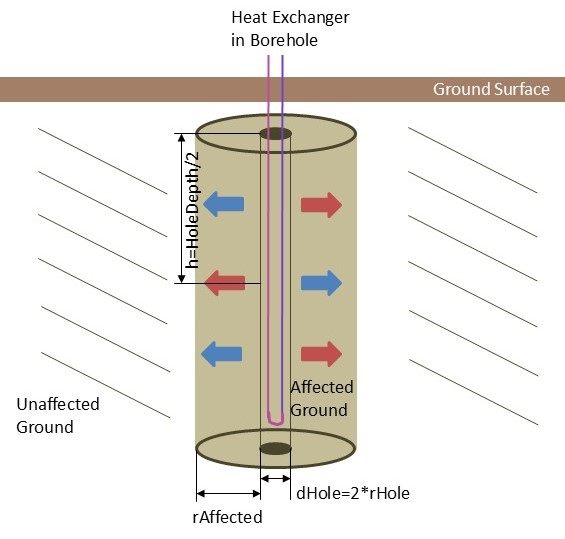
It is assumed that the affected grounds of the HeatExchangers do not influence each other and that all heat exchangers are used parallel. This means that the affected ground has the same temperature for all heat exchangers. The temperature of the affected ground is determined by the heat input or extraction of the medium as well as the heat conduction between the affected and unaffected ground. Seasonal influences, characterized by TAverageAmbientAnnual, TAmbientMax and MaxMonth in the environment model, are also taken into account for the affected and unaffected ground. The vertical collector is calculated using the mean depth (temperature at HoleDepth /2), as the model assumes a uniform ground temperature over the entire ground depth.