B6Converter
Symbol | 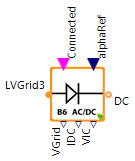 |
|---|
Use
The B6Converter transfers electrical energy from a DC component to a 3-phase low-voltage grid. The DC voltage is controlled via a reference delay angle using a B6 controller.
Recommendation: A fully coupled model for the conversion from battery dc to an ac connection is already available as Batt2ACInverter or for the conversion from dc to ac view the grid inverter component.
Parameters and Connectors
To integrate the B6Converter, the connectors ▶LVGrid3 to the ac grid and ▶DC to the dc component must be connected. The parameter alphaRef determines the delay angle of the ac current, and the boolean connector Connected specifies whether the component at the connector ▶LVGrid3 is currently connected to the grid. This is important because some components may be temporarily disconnected from the grid (e.g. eVehicle at charging station) and are unavailable during this time.

Only the efficiency of the conversion process eta needs to be set as a parameter. If no value is known for this parameter, the current default value can be used.
Model Background
Converter Scheme
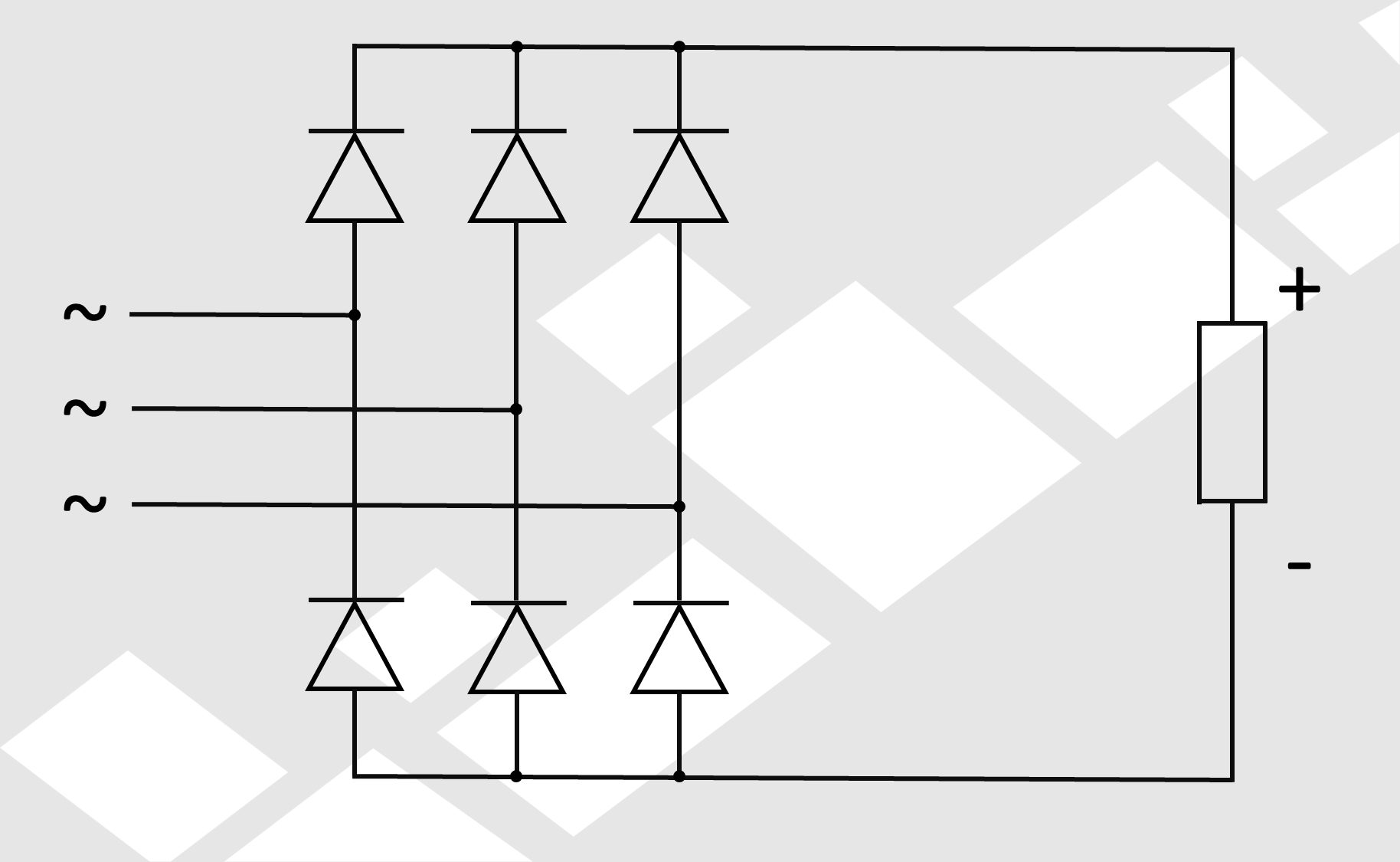
The electrical functioning of the B6Converter can be understood using the following diagram:
Average rectified value
The factor in the B6Converter right next to the parameter VGrid has a value of 2.34 and is the average rectified value of a B6Converter. This average rectified value is the average value of the absolute value of the voltage and describes which dc current would transport in average the same electrical charge as the rectified ac current within the same period of time.
The maximum DC voltage is dependent on the average rectified value and the RMS-voltage of the local grid (2.34 times the RMS-voltage, normally 538V). Note that the converter efficiency can be included into the calculation.