VolumeFlowController
Symbol | 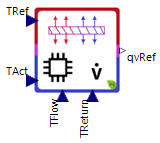 |
|---|
Use
The volume flow controller, controls the volume flow of combined heating and cooling systems (radiant panels, radiant loops) dependent on the power needs and current system temperature.
Parameters and Connectors
Basic
The heating system temperature must be defined on the basis of the actual temperature (▶TAct) of a specific water layer. A reference temperature (▶TRef), the flow temperature (▶TFlow) and the return temperature (▶TReturn) at the heating and cooling system are also required to define the controller output (▶qvRef), which can be connected to ventilation system as a reference input.
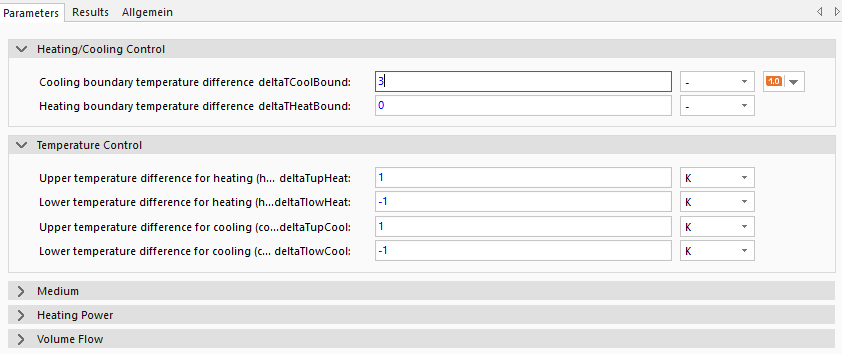
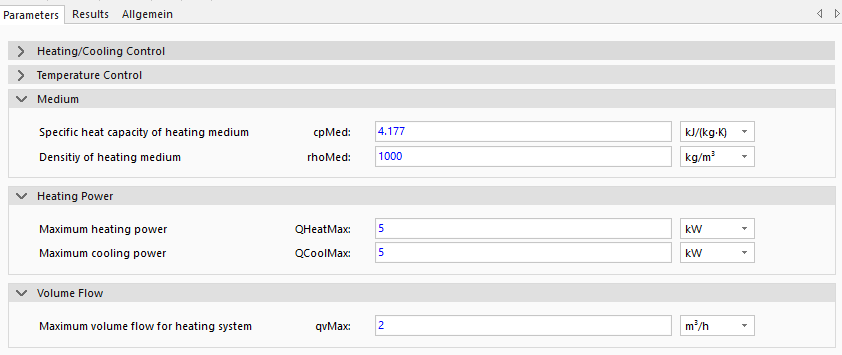
The output is defined in such a way that if the actual temperature ▶TAct falls below the reference temperature ▶TRef by deltaTlowHeat plus deltaTHeatBound the heating is started and if the actual temperature ▶TAct rises above the reference temperature ▶TRef by deltaTupCool plus deltaTCoolBound the cooling is started.
The volume flow ▶qvRef output has a value above zero until the reference temperature ▶TRef is exceeded by deltaTupHeat plus deltaTHeatBound during the heating process or is reduced by deltaTCoolBound plus deltaTlowCool during the cooling process. The maximum volume flow output is qvMax, limited by QHeatMax and scaled linearly between these two points. In order to calculate the heating capacity correctly, the specific heat capacity (cpMed) and the density (rhoMed) of the heating medium must be defined.
Model Background
Control Logic
Heating or cooling depend on the input reference temperature ▶TRef and the corresponding boundary parameters (i.e. deltaTHeatBound and deltaTCoolBound):
if (TAct-TRef)<deltaTHeatBound+deltaTupHeat, heating is enabled
if (TAct-TRef)>deltaTCoolBound-deltaTlowCool, cooling is enabled
Caution should be taken when defining the temperature control parameters to avoid numerical difficulties (e.g. deltaTHeatBound+deltaTupHeat < deltaTCoolBound-deltaTlowCool).
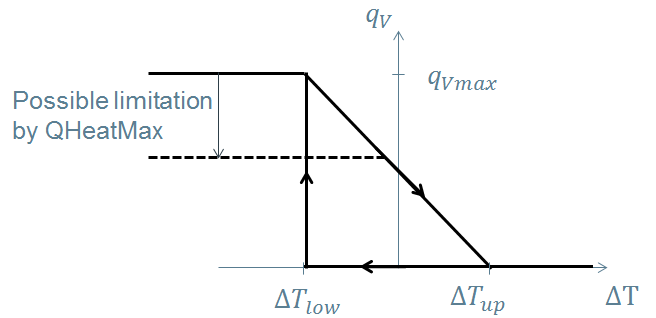
Here is a schematic representation of the control logic for the heating.
The following logic is applied for heating and cooling, respectively
Heating:
if (TAct-TRef)<deltaTlowHeat, the reference heat power output is maximum.
if (TAct-TRef)>deltaTUpHeat, the reference heat power output is set to zero.
Between the two temperature boundaries the reference heat power output is linearly interpolated.
Cooling:
if: (TAct-TRef)<deltaTlowCool, the reference heat power output is set to zero.
if: (TAct-TRef)>deltaTUpCool, the reference heat power output is maximum.
Between the two temperature boundaries the reference cooling power output is linearly interpolated.
The calculation of the reference volume flow ▶qvRef is slightly different for the heating and the cooling process.
Heating:
Cooling:
The reference heat power output is controlled via reference volume flow in the heating system and the related difference between flow and return temperature.