Boiler
Symbol | 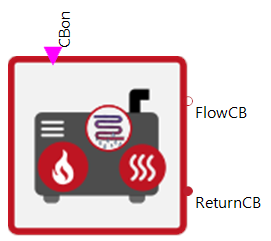 |
|---|
Use
Condensing boilers are central-heating boilers which convert, almost completely, the energy content of fuel into heat power output. The high system efficiency results from the usage of condensation (latent) energy of water vapor contained in the exhaust gas. Normally, natural gas, oil or wood are used as fuels.
The Boiler covers the following applications:
Basic: A switch-on and switch-off signal is provided to the Boiler, so it is either on at full power or completely off. The heat output and efficiency are defined by the input curves and depending on the flow temperatures at the heating circuit.
Modulation: The heat output of the Boiler is additionally modulated, so it is not only switched on and off, but can also only call up part of its maximum output during operation.
Cascade: This assumes that the Boiler has several generator stages (burners) or that there is a cascade of Boilers. These are used one after the other depending on the input signal ▶ActiveUnits.
Parameters and Connectors
Basic

The Boiler is connected to the heating circuit via ▶FlowCB and ▶ReturnCB. It is turned on via a 'true' signal at the ▶CBon input.

The boiler size can be adjusted via the parameter HeatPower. This is the nominal heat power output of the boiler. The parameter eta adapts the efficiency. This should correspond to the following specification of the fuel (heating value/calorific value).
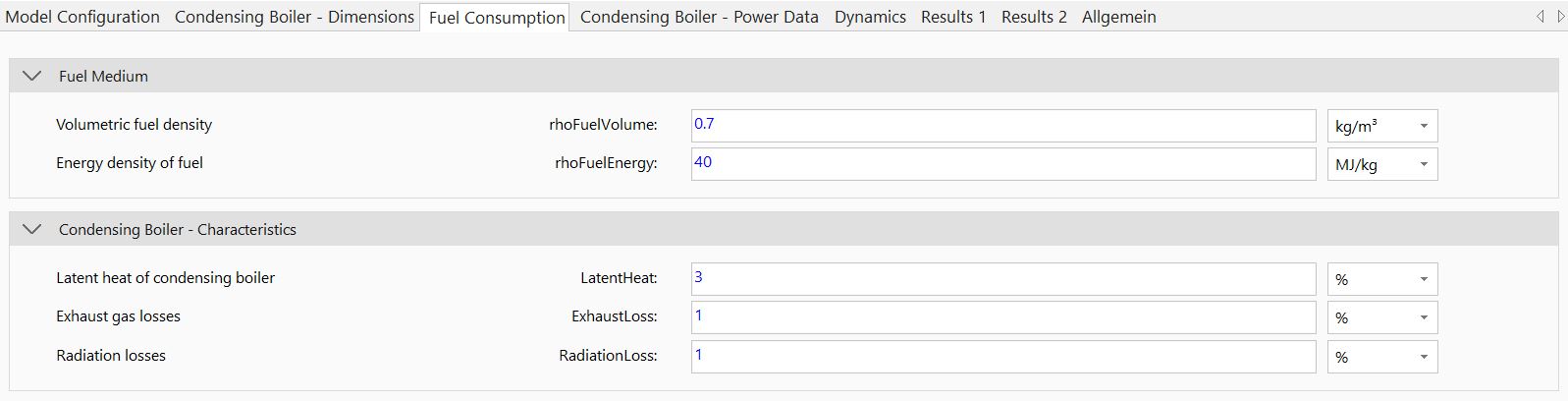
The parameterization of fuel type is done within the parameter dialog via volumetric (rhoFuelVolume) and energy density (rhoFuelEnergy) of the used fuel. Normally, this can be natural gas, oil or wood. The efficiency calculation is the main part of the presented boiler model. Here the calculation additionally depends on the relative latent heat (LatentHeat), relative exhaust losses (ExhaustLoss) and radiation losses (RadiationLoss). These values must be parameterized in the parameter dialog. If no concrete information is available, use the pre-defined parameter sets.
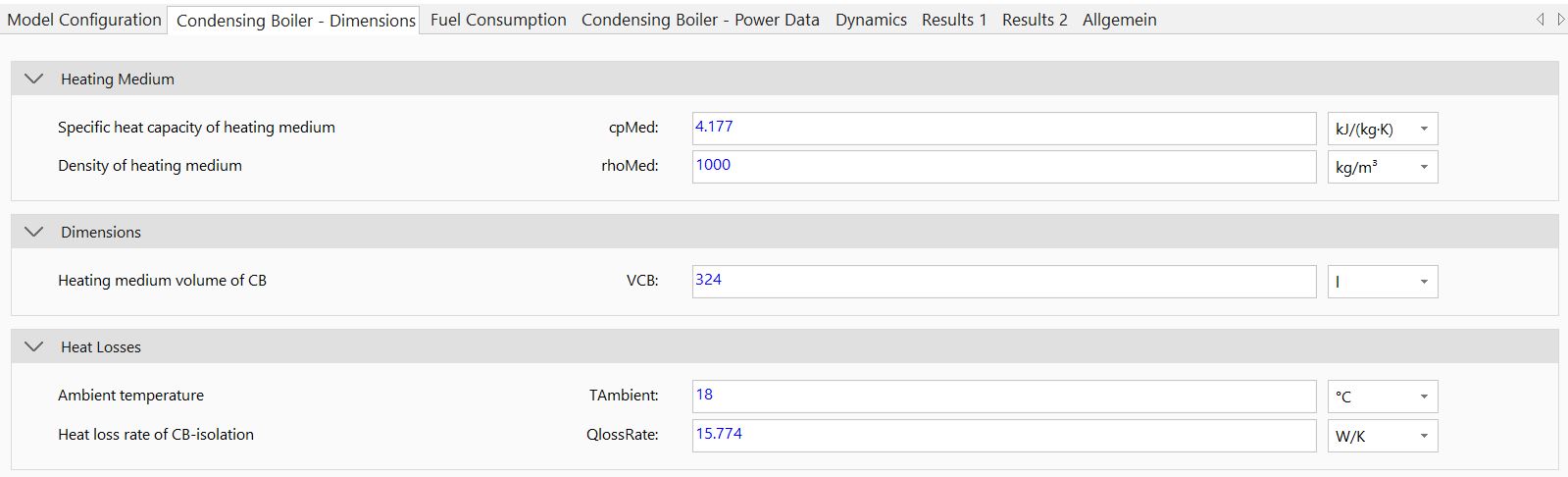
The properties (cpMed, rhoMed) and volume (VCB) of the heat transfer medium on the sink side must also be parameterised correctly. In addition, internal heat losses in the heat pump can be mapped via TAmbient and QlossRate.

The internal dynamics (tThStart) of the model regarding heat production can also be adapted. If specific data for this is not available, the pre-defined parameters should be used.
Modulation
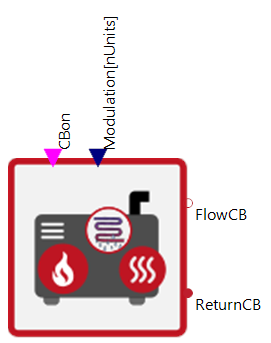

If the parameter UseConstantPowerOutput is set to 'false' the model represents a condensing boilers whose heat power output is modulated continuously. The technological limit of the minimum modulation (RelModMin) is also taken into account.
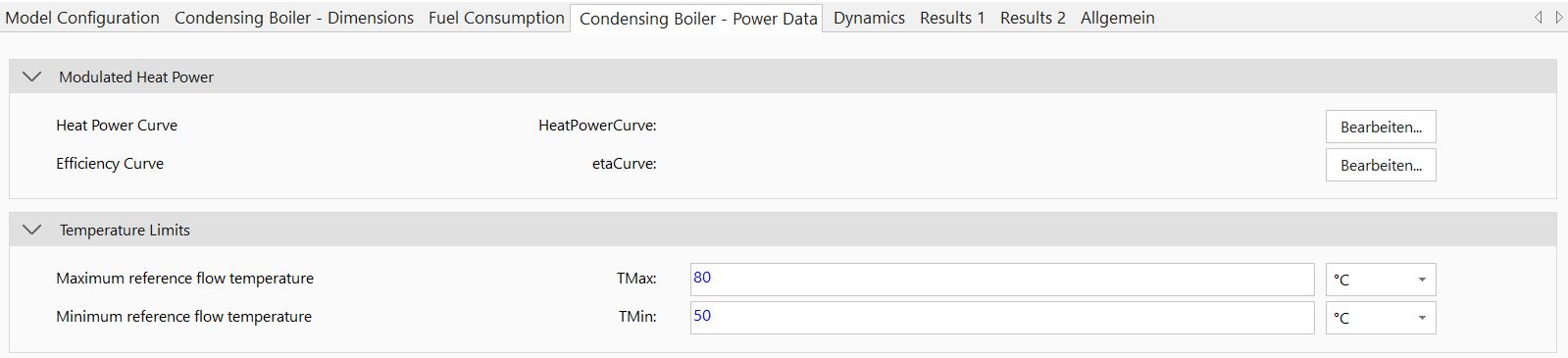
If the heat power is modulated, the boiler efficiency and actual heat power must be configured using flow temperature depending curves (HeatPowerCurve, etaCurve). To prevent these tables from being extrapolated too far, the minimum and maximum temperature (TMin and TMax) must be set.
Cascade
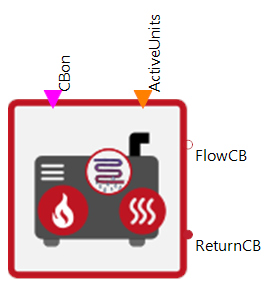

Important to note is that when parameterizing cascaded boiler systems the parameter nUnits is used to describe the number of cascaded steps. If this number is greater than 1, the connector ▶ActiveUnits is released. This can be used to control the active number of stages.
In general, the total heat power must be specified in the HeatPowerCurve. As an example, if the data sheet of a boiler unit is available and two stages are required, the outputs in the data sheet must be multiplied by 2 and inscribed in the HeatPowerCurve table, accordingly.
Model Background
Efficiency Calculation
The efficiency is calculated by the following formula:
Fuel Parameter Sets
To enable the simulation of different types of condensing boilers or normal boilers with reduced system efficiency, the following parameter sets can be defined in the parameter dialog:
Constant temperature boiler: LatentHeat=6%, ExhaustLoss=10%, RadiationLoss=20% --> resultant system efficiency: 66-70%
Low temperature boiler: LatentHeat=6%, ExhaustLoss=6%, RadiationLoss=1% --> resultant system efficiency: 88-93%
Condensing boiler: LatentHeat=3%, ExhaustLoss=1%, RadiationLoss=1% --> resultant system efficiency: 95-99%