DomesticWaterLoad
Symbol | 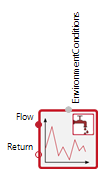 |
|---|
Use
This component can be used to imitate a thermal load for hot water preparation, generated from an existing time series of hot water demand. The time series can be read and imported into the simulation from a text file containing the hot water demand as volume flow.
Parameters and Connectors
Basic
For the load data import the path to the text file must be specified by the parameter File and the table name (name of the values column within the text file) by the parameter Table. Note that the input data set (i.e. volume flow characteristics) must be defined using SI units (e.g. volume flow = m³/s). The timebase of the load table can either be supplied in hours of year (useDayTime=false) or in hours of a day (useDayTime=true). Using the latter format, simulations longer than a day will repeat the given load curve accordingly.
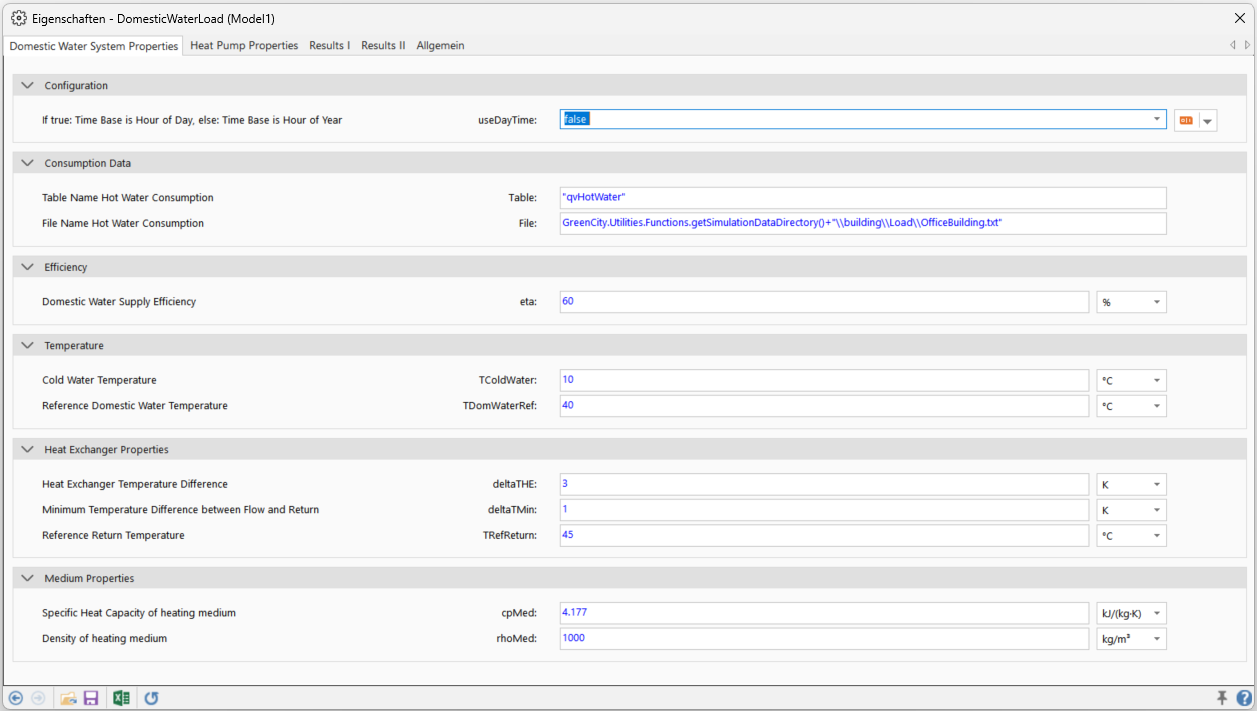
The required hot water temperature can be defined using the parameter TDomWaterRef. However, a sufficient heating temperature is not always available. Therefore, the actual hot water temperature (THotWater) is calculated from the given reference temperature TDomWaterRef, the available flow temperature, and the heat exchanger efficiency deltaTHE using the following equation:
The required domestic water heat (QHeat) is determined using the previously calculated hot water temperature, the volume flow from the demand data table, water characteristics, cold water temperature (defined by TColdWater) and overall domestic water distribution efficiency eta (standard of 60% corresponding to modern circulation systems without large storage capacities, takes into account circulation and storage losses) using the equation supplied:
Based on QHeat the required (i.e. to cover the demand load) volume flow of a heating medium is calculated using the following equation, taking into account the heating medium density and heat capacity rhoMed and cpMed:
To solve the equation also the temperature of the incoming medium at the Flow connector and a return temperature are considered. The return temperature has to be defined by the component. Thus a reference temperature is set with parameter TRefReturnHeat as an absolute value. To prevent high volume flows, a minimum temperature difference between flow and return temperature can be defined. The model equation will always use the maximum temperature difference between TRefReturn and deltaTMin.
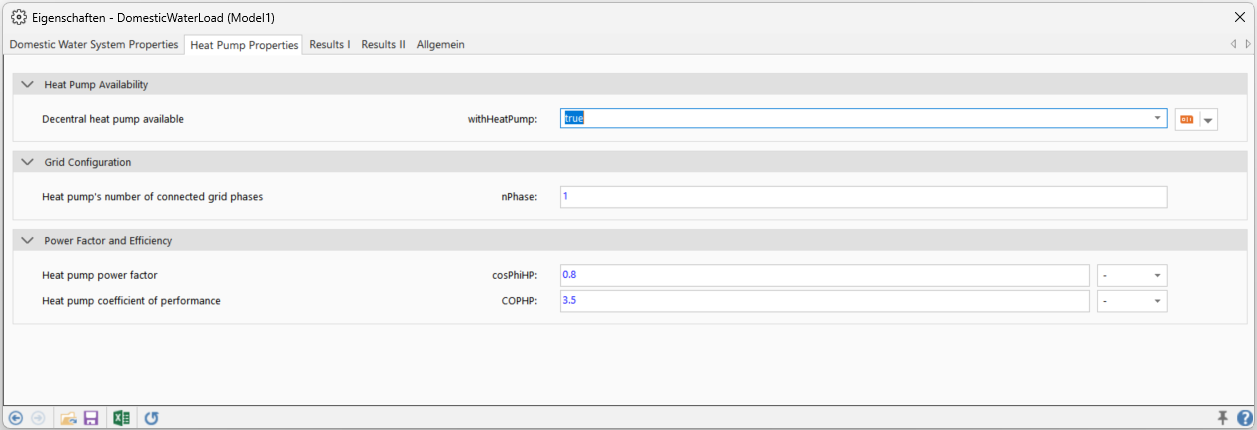
Furthermore, the model can add simple heat pump functionality when the parameter withHeatPump on tab Heat Pump Properties is set to true. In case of low temperature district-heating grids, the lower grid heat is elevated to a higher temperature level via a heat pump. Instead of the full heating power required, only the source power is then drawn from the connected heat supply. The required electrical power input is defined via the parameters COPHP and cosPhiHP. A low-voltage grid connection can be established via single- or three-phase grid connection (nPhase).
The Connector ▶EnvironmentConditions has to be connected to an Environment block to provide the current time of year and time of day for reading the text file. The ▶Flow and ▶Return connectors should be connected to a heat supply system (ideally indirectly via a storage tank). The connected heating supply should define the flow temperature. The volume flow and return temperature are calculated by the DomesticWaterLoad component. If the component has been parameterized for calculation with a heat pump, the electrical connection (depending on the parameterization in nPhase ▶Grid1 or ▶Grid3) must be connected to the electrical power supply. A single-phase connection can be connected to the grid via the PhaseTap component (from Utilities), while a three-phase connection can be connected directly to a grid component.
Model Background
From the parameterised text file, the value corresponding to the current timestamp is read into the model. The values are interpreted as tapped hot water volume flow power in m³/s. Linear interpolation is applied between the individual table points, and extrapolation is performed outside the given time series.