ElectricallyHeatedBoiler
Symbol | 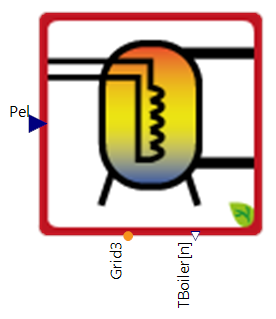 |
|---|
Use
Heating boilers are used to store hot water for the hot water supply. In contrast to heat storage, electrically heated boilers can be supplied with heat by internal electric heating elements. These boilers are therefore more independent of the building's heating systems. As with thermally heated boilers, the heat can be extracted directly via the volume flow or indirectly via heat exchangers.
Parameters and Connectors
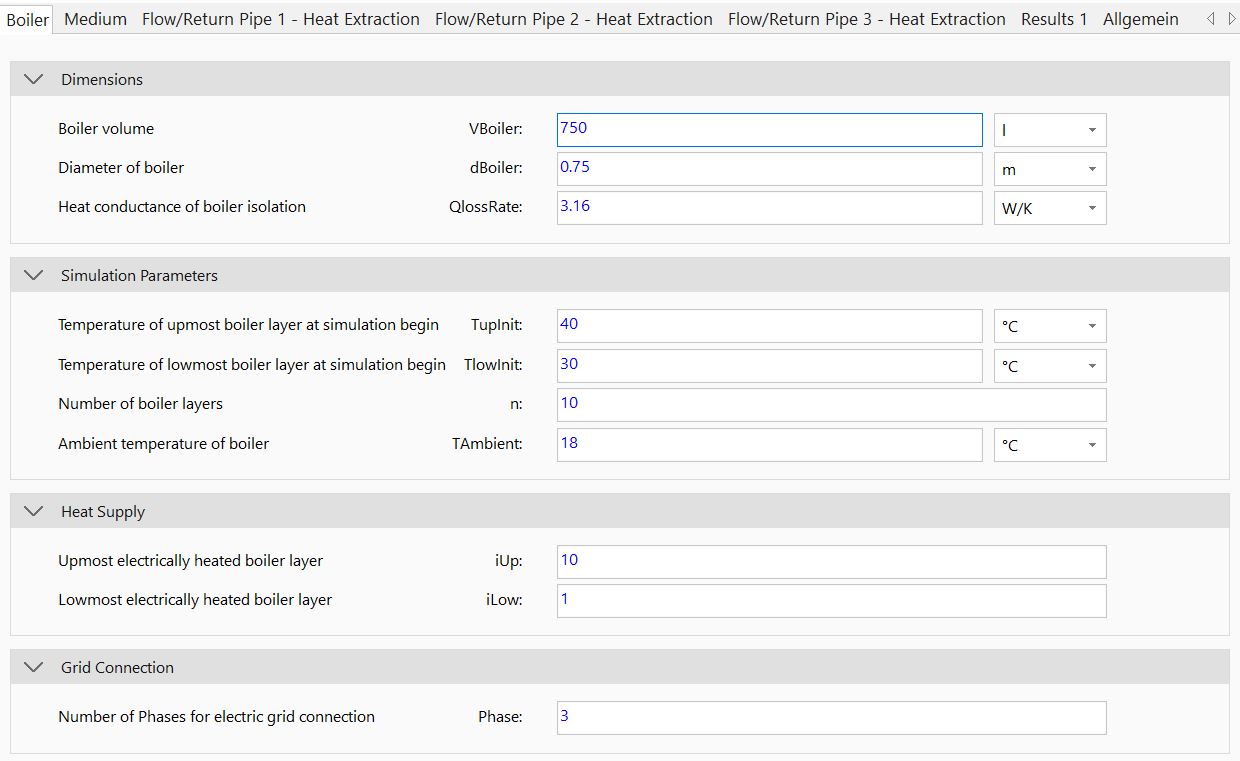
The electrical heating input (▶Pel) must be transmitted to this boiler. As it is therefore an electrical consumer, it must also be connected to a network model (default ▶Grid3). The number of simulated phases can be set here via the Phase parameter. It is assumed that the electrical heating power is applied evenly to the heated layers (iUp to iLow).
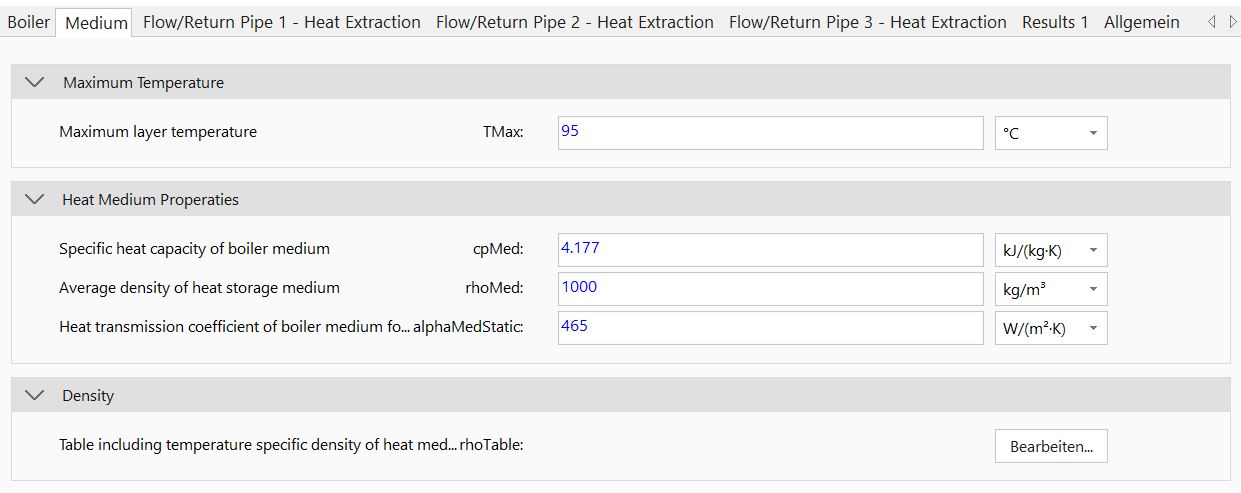
The boiler model consists of a free parameterizable number (n) of neighboring water layers (number 1 is the bottom layer, number n is the top layer). Make sure that the output water is defined with the same media constants (e.g. parameters of the hot water supply model, i.e. the tap) as the boiler so that correct energy extraction is simulated.
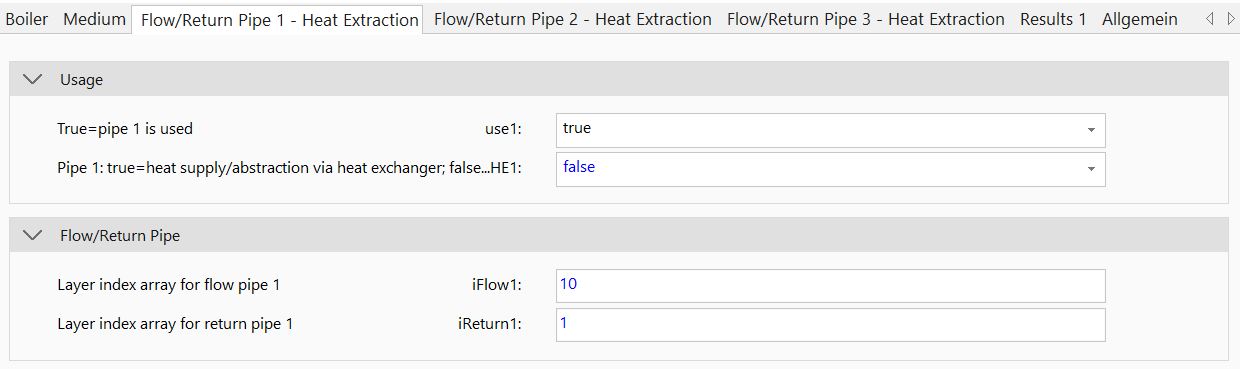
It is possible to define up to 3 tapping points on the boiler (use1 to use3). For each tapping point, the layer from which the water is extracted (iFlow1) and to which the water is returned cold (iReturn1), can be defined. It can be decided for each tapping point whether the water is to be tapped directly or only heat is to be tapped via heat exchangers (HE1).
The modelling of the storage itself and the parameterization of the tabs Boiler and Medium is described in the HeatStorageCombined model.
Model Background
The modeling of the storage behavior is described in detail in the HeatStorage model.