HeatingUnitParallel
Symbol | 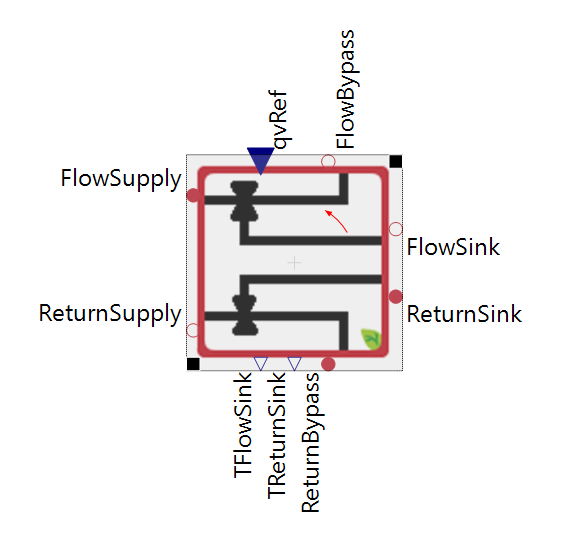 |
|---|
Use
This HeatingUnitParallel component enables the parallel connection of several heating system models with one heat supply system. That way, the volume flow to the connected heating system is controlled by an external heat controller. The remaining volume flow of the heating medium bypasses the heating system via an external bypass pipe. In this configuration the flow temperature for each connected heating system remains the same as the heat supply temperature level.
Recommendation: Use alternative version DistributorNPort and MergingValveNPort.
Parameters and Connectors
▶FlowSupply refers to the flow coming from the supply side. At this point, the heating fluid, including its temperature and volume flow, is transferred into this model. ▶ReturnSupply represents the return flow back to the heating supply. Here, the cooled fluid is directed back to the storage system or heater.
▶FlowSink refers to the flow going to the sink side. At this point, the heating fluid, including its temperature and volume flow, is transferred out of this model. ▶ReturnSupply represents the return flow back from the heating sink side. Here, the cooled fluid is coming back from the heating zone.
▶FlowBypass is the flow output to the external bypass and ▶ReturnBypass is the return input from the external bypass. Parallel heating units can be connected here.
▶qvRef refers to the reference volume flow of the heat sink, which is typically defined by a heating controller VolumeFlowControllerHeatingSystem. ▶TFlowSink describes the actual flow temperature of the sink. ▶TReturnSink describes the actual return temperature of the sink. Both outputs are required by the heating controller VolumeFlowControllerHeatingSystem.
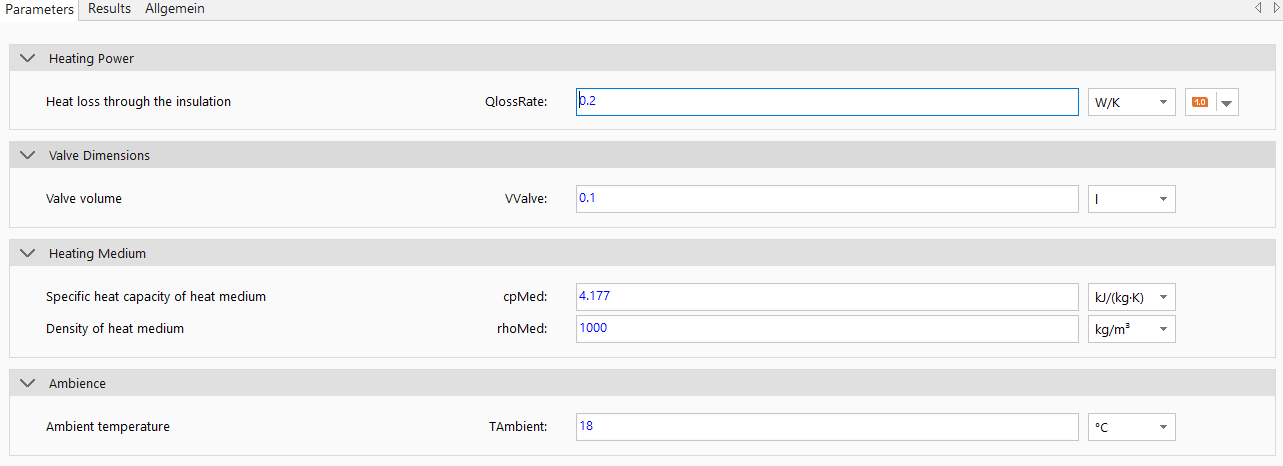
QlossRate describes the heat loss through the insulation. VValve decribes the volume in the valve. The parameters of the fluid are described by cpMed average specific heat capacity and rhoMed average density. TAmbient defines the ambient temperature at the location of the model. If the unit is placed in a heated zone, this corresponds to the temperature of that zone. If it is located outside, it corresponds to the outside temperature. This parameter is required for calculating heat losses.
Examples
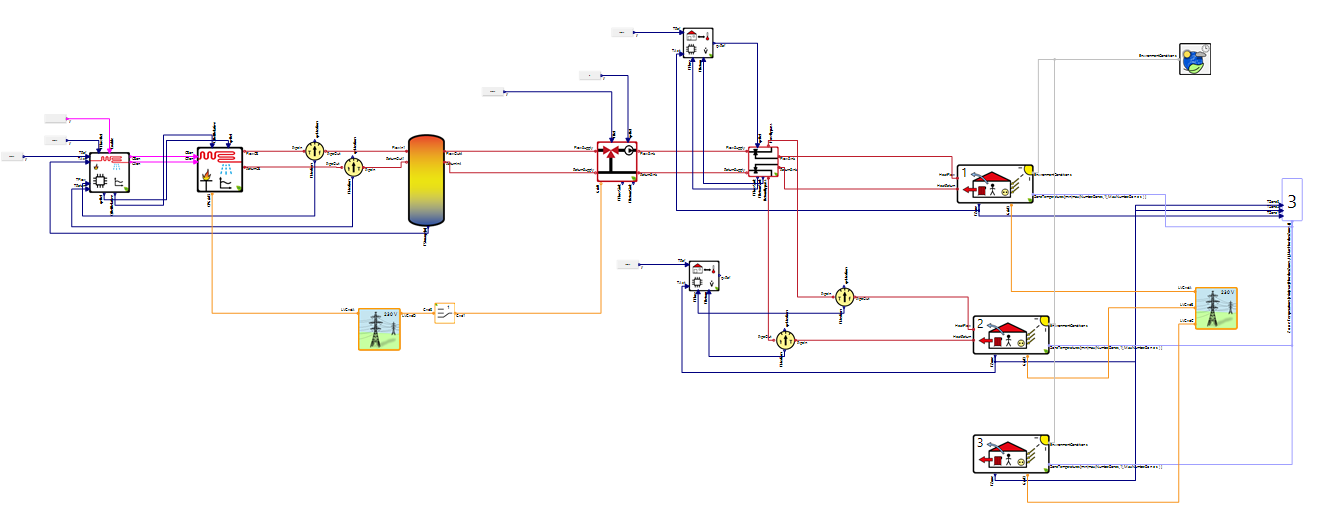
This image shows an example of how a HeatinUnitParallel can be integrated.