RadiantPanels
Symbol |  |
|---|
Radiant panels are combined heating and cooling surfaces on walls or ceilings which can either provide heating or cooling power to a room or complete building. The main model task is to calculate the supplied heating and cooling power dependent on current flow temperature, return temperature and hydronic volume flow. Furthermore, another characteristic model output is the corresponding return temperature of the hydronic system depending on parameterized heating/cooling transmission values and internal thermal inertia.
The RadiantPanels covers the following applications:
Basic: RadiantPanels for wall-mounted systems which are designed based on the cooling power
Panel Design With Heating Power: Panel design is done by the heating power
Ceiling Panels: RadiantPanels are mounted on the ceiling
Parameters and Connectors
Basic
The RadiantPanels has the following connectors the heat medium inlet ▶Flow, the heat medium outlet ▶Return, and the target temperature of the room ▶TZone. In addition, the heating or cooling capacity of the RadiantPanel ▶QHeatCool is also output as a connector.
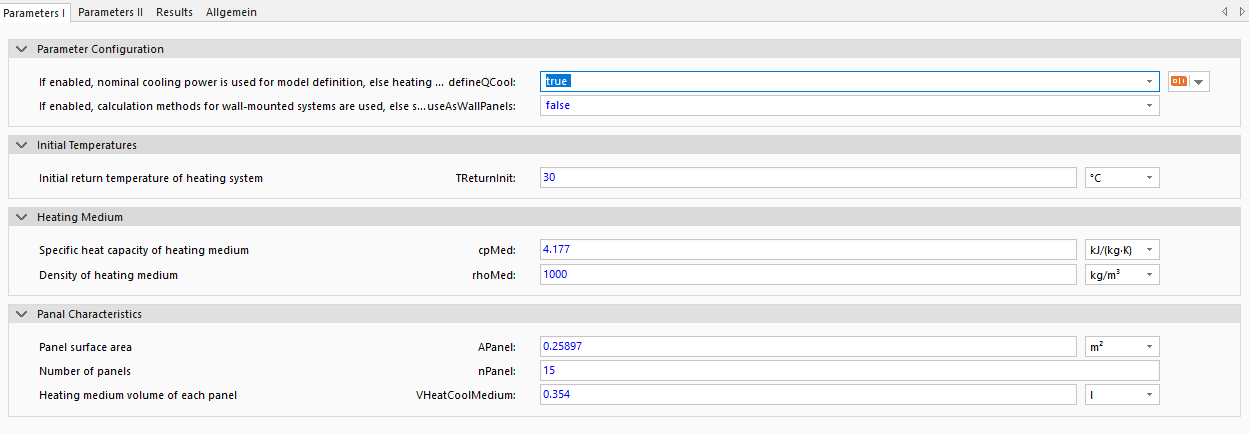
The parameter defineQCool determines the layout of the panels based on the nominal cooling capacity (defineQCool is true). This depends on the available data for the RadiantPanels. The panels can be mounted either on the wall (useAsWallPanels is true) or on the ceiling (useAsWallPanels is false). The calculation of heat transfer changes accordingly.
To ensure numerical stability during initialization, the initial return temperature should be set to TReturnInit at this point in time in accordance with the expected temperature at this point in time. In most cases, the default setting of 30°C is sufficient.
The heat transfer medium of RadiantPanels is determined by the specific heat capacity cpMed and density rhoMed of the heat transfer medium.
Additional parameters for calibrating the models can be found in the data sheet, including the surface area of the panels APanel, the number of panels nPanel, and the volume of the heat transfer medium within each panel VHeatCoolMedium.
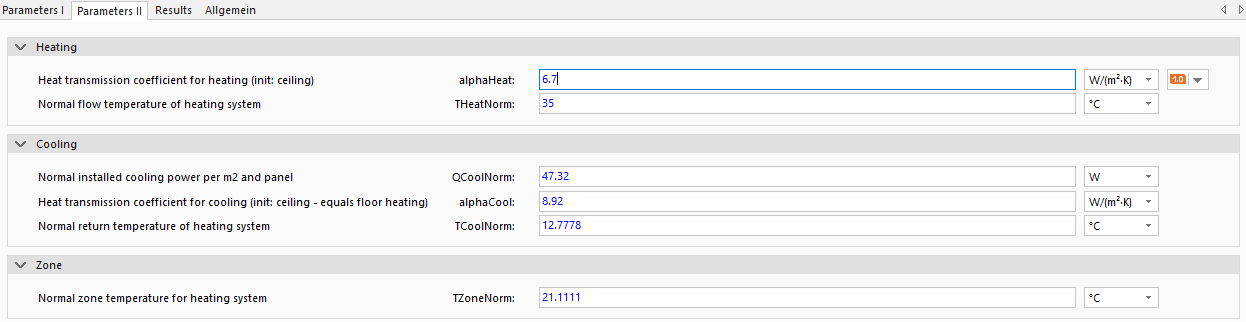
The wall panels are physically determined using a heat transfer coefficient for heating alphaHeat and the nominal temperature of the system in heating mode THeatNorm.
The nominal cooling capacity QCoolNorm, the nominal heat transfer in cooling mode alphaCool, and the nominal temperature in cooling mode TCoolNorm from the data sheet are required for the design. To determine the heat transfer, an approximate temperature TZoneNorm for the room to be heated or cooled must be specified. This temperature is normally between 20-23°C. A more detailed overview of how to calculate the heat output can be found here.
Panel Design With Heating Power

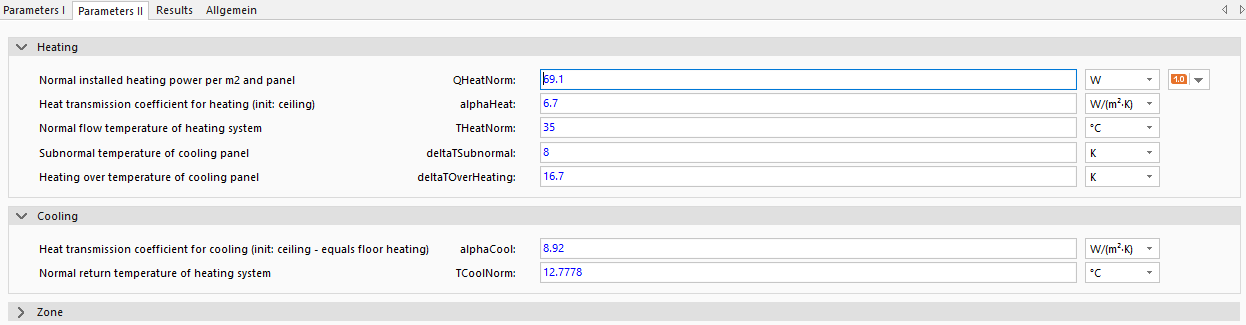
If the ceiling panels are designed based on heat output (defineQCool is false), the parameters are nominal heat output QHeatNorm, heat transfer coefficient alphaHeat, nominal temperature THeatNorm, maximum subcooling of the cooling panel deltaTSubnormal, and maximum superheating of the cooling panel deltaTOverHeating. The subcooling and superheating of the panels ensure that the design is adjusted to the heat output of the exact configuration of the RadiantPanels.
Ceiling Panels

If the panel is to be mounted on the ceiling (parameter useAsWallPanels is true), the heat transfer coefficients for cooling and heating within the model change.
Model Background
Heating and Cooling Power Calculation
Concretely, the current heating or cooling power is calculated using the systems current medium temperature TWater, current room temperature TRoom, partial heat transmission coefficients kappa and corresponding heat transfer coefficient alphaHeat or alphaCool.
The partial heat transmission coefficient kappa represents nominal heating or cooling power of a modeled hydronic heat transfer system including the thermal inertia of the surrounding surface (i.e. floor, ceiling, panel). It is internally calculated in the model by considering nominal heating or cooling power (according availability - defineCool) and nominal temperatures (e.g. nominal flow temperature of floor heating system is about 35 °C, nominal room temperature is about 21 °C).
The corresponding heat transfer coefficient alpha represents heat transfer between the heated surface and the room itself. For heated walls and cooled floors it is constant at a value of 6.7 W/(m2K). For heated walls and cooled ceiling on the other hand, the following basic characteristic of floor heating systems is used to calculate this value:
Here, nominal temperatures either for cooling or heating are inserted in this equation to calculate the corresponding temperature difference which in turn is dependent on the nominal heating or cooling power output.
Note however that wall mounted systems differ slightly and thus The following equation is applied for calculating heating and cooling processes:
The radiant panel model is parameterized with size and number of installed panels and the corresponding nominal heating or cooling power. The heating and cooling power of individual systems are often co-dependent as per system design and characteristics. The individual powers of each system are not always available or calculable. Due to this the following equation is used for calculation: