HydroElectricPowerStation
Symbol | 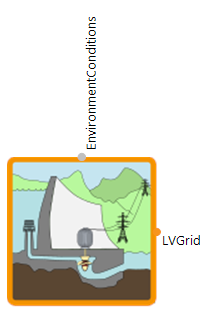 |
|---|
Use
A hydroelectric power station uses the kinetic energy of flowing water to produce electricity. The water flow can either be man-made (e.g. dams or reservoir) or natural (e.g. river or waterfall).
Parameters and Connectors
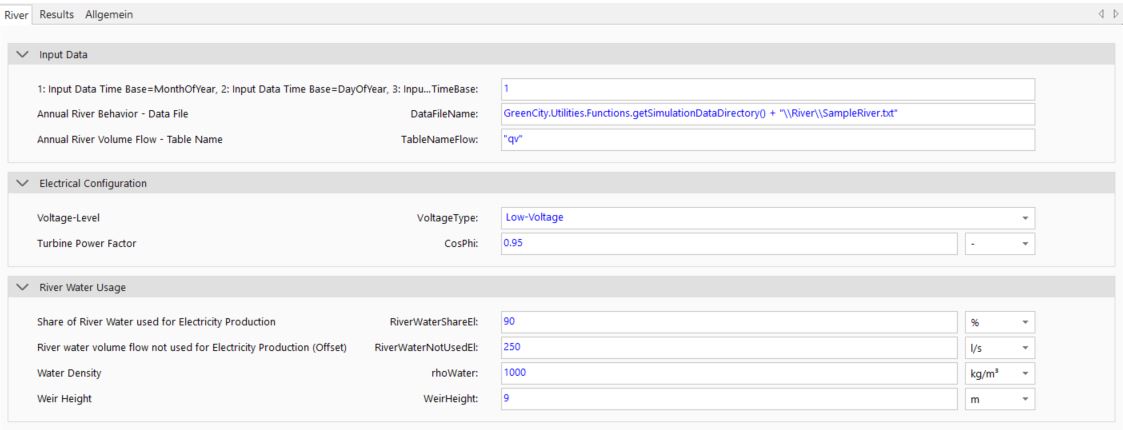
The connector ▶LVGrid can be used to connect the power station to other electrical models to distribute the produced power. With the parameter VoltageType the connector type (i.e. low, medium and high-voltage) to surrounding electrical models can be chosen. The parameter CosPhi defines the ratio of active power to apparent power.
An external textfile (integrated by the parameter DataFileName and TableNameFlow) characterizes the annual volume flow of the river used for power generation. The first column in the file contains the timestamps. Note that the parameter TimeBase should match the unit used for the timestamps. The second column contains the time-dependent volume flow values, which must be supplied in the unit of m³/s. The ▶EnvironmentConditions are used to have the time base inside the model.
By editing RiverWaterShareEl and RiverWaterNotUsedEl the amount of water used for electrical power production can be defined. The volume flow RiverWaterNotUsedEl is subtracted from the overall volume flow defined in the input table. The parameter RiverWaterShareEl defines the proportion of the remainder that is actually used to generate electricity. If this is set to 100% and RiverWaterNotUsedEl to 0 m³/s, the complete water flow defined in the textfile is used to produce electricity.
Another important parameter is the WeirHeight, which describes the difference in height up to the turbine and thus defines the velocity of the water. In conjunction with the density of water (rhoWater), this has a significant impact on the energy generation potential of the power plant model.
Model Background
The electrical power production is calculated as follows: