PV2ACInverter
Symbol |  |
|---|
Use
The PV2AC converter model is necessary to couple a photovoltaic system model with an AC-grid.
The converter covers the following applications:
Basic: The photovoltaic system is coupled to a 3-phase connection.
1-phase Connection: The photovoltaic system is coupled to a 1-phase connection.
Parameters and Connectors
Basic
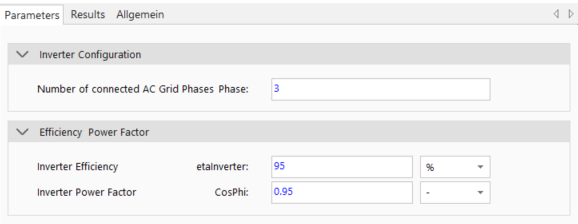
The converter connects a PV system (▶DCPV) and an AC grid (▶LVGrid3). The photovoltaic converter uses the resulting maximum-power-point voltage (▶MPP) to control the intermediate-circuit voltage on the PV-side. Make sure that ▶MPP-connector is connected with the correspondent PV system. This ensures that the PV systems provides maximum electrical power output at all times. The maximum voltage of a 3-phase converter is 2.34 times the effective grid voltage. The parameter etaInverter represents internal losses of the converter and reduces the power output to the DC grid. The power factor CosPhi of the inverter defines the ratio between the real and the apparent power. This configuration uses the DCDCConverter model and the B6 converter.
1-phase Connection
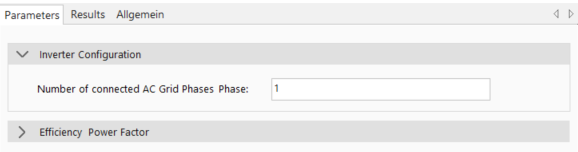
With the model and the adjustment of the phase parameter (see figure above), it is also possible to model a single-phase system. However, this is subject to the condition that the related maximum open-circuit-voltage of the PV system does not exceed a value of 0.9 times of the effective grid voltage. Using the PV converter model as a single-phase converter avoids high reactive power demands for voltage conversion. In this configuration the B6 converter is replaced by the B2 converter.
Model Background
A PV system is normally, controlled by MPP-Tracker, a system regulating the intermediate-circuit voltage at PV-side without knowing the actual available MPP-voltage and current. Such a tracker uses measurements for voltage and current output for power regulation. These complex control algorithms are not included to reduce system complexity in the provided controller model.