BatteryStorage
Symbol | 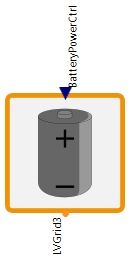 |
|---|
Use
The BatteryStorage can be used to buffer peaks of renewable energy production and electricity demand in buildings or in combination with other electrical consumers. The BatteryStorage combines the detailed model components of a stationary battery and an inverter into a complete electrochemical storage system (battery) with an ac grid connector. The presented battery model is a highly dynamic, battery-cell impedance model including the following components:
Variable voltage source (dependent on SoC) representing an open-circuit-voltage
Ohmic resistance (dependent on cell temperature and SoC) representing internal ohmic resistances
Constant-phase-elements (dependent on cell temperature and SoC) representing high and low, internal resistance dynamics
Battery to AC Inverter for direct model to grid connection
Parameters and Connectors
As connectors, the BatteryStorage requires a connection to a 3-phase ac model (e.g. the Grid) via ▶LVGrid3 and a battery target power via the connector ▶BatteryPowerCtrl. Compared to the individual model components stationary battery and inverter, the combined BatteryStorage is easier to parameterize, which was realized by a limited number of parameters compared to the individual components. If the battery ageing or the individual parameter characteristics such as voltage or resistance are important in the evaluation, then it is recommended to re-parameterize the components of the battery model stationary battery and battery inverter or to rebuild the BatteryStorage with the components mentioned.
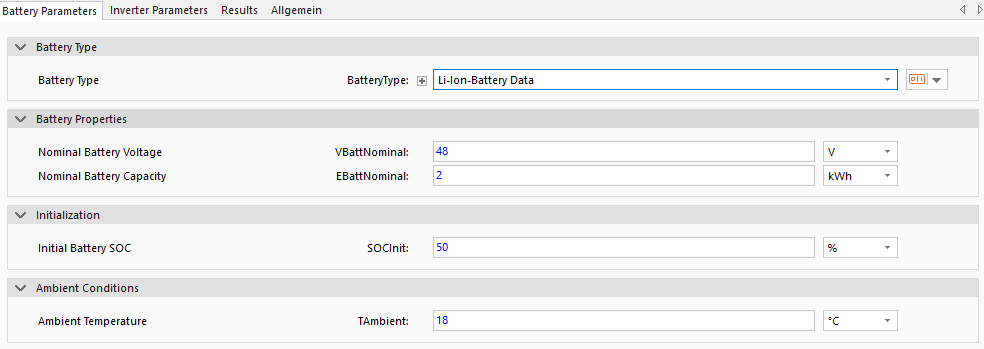
The typical battery parameters (see Battery model) are set in the BatteryParameters tab with the battery type BatteryType, the nominal total battery voltage VBattNominal, the nominal total battery capacity EBattNominal, the initial battery SoC SOCInit and the ambient temperature of the battery TAmbient (assumption of a constant ambient temperature).
Due to the overall goal of simulation time reduction, the battery is modeled as a variable amount of battery cells or modules. It is assumed that all cells and modules of the battery show the same behavior. VBattNominal and EBattNominal is used in combination with the typical battery parameters BatteryType to calculate the internal number of battery cells. The battery parameters are stored in the records Li-ion battery and Lead-acid battery, which in turn are derived from the standard battery type record. If a special type of battery cell or module is to be simulated, additional battery data can be imported into this package and the model data directory, using the existing records and data-files as a template.
The details of the battery parameters can be found under the StationaryBattery model.
Please note that a hysteresis of 5% is implemented in the control model (see also BatteryCharger). This ensures that the battery is not charged or discharged, even when a battery target power is specified, until a deviation of at least 5% from the maximum or minimum SOC is reached.
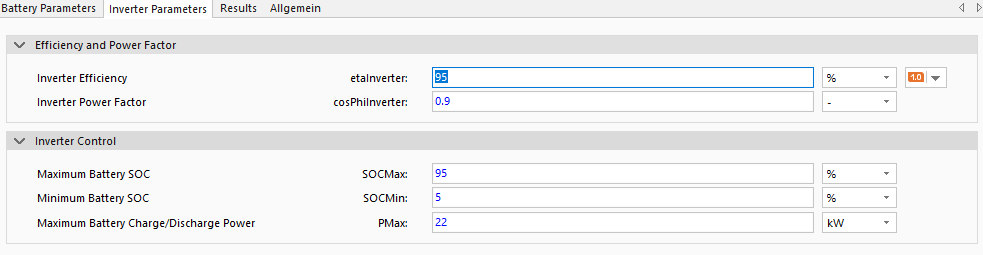
A shortened selection of the Inverter parameters is used to set the inverter parameters. The parameters are the electrical conversion efficiency of the inverter etaInverter, the power factor of the inverter cosPhiInverter (degree for the usable power on the ac side), the maximum achievable battery SoC SOCMax, the minimum achievable battery SoC SOCMin and the maximum charging or discharging power of the battery PMax.
Model Background
SoH And SoF
Battery aging is modeled automatically and uses data from the BatteryData records. The aging of a battery is dependent on the simulated battery temperature, overall capacity and cycling. To consider these factors the battery aging model is included into the simulation process. Note that extended battery aging analyzes can be conducted using specialized battery-aging data. To obtain such data extensive measurements are however required. The output of the battery aging simulation results are converted to the SoH value (state of health, value of the battery model inside the model compound) dependent on cyclization or battery capacity. Note that SoH is always initialized with 100%. It is thus assumed that a simulated battery is always new when simulation time begins. Normally a battery reaches the end of life when the SoH drops below 80%.
The State of function (SoF, value of BatteryStorage inside the model compound) is an additional simulation result accumulating the battery aging and actual temperature to a single value that represents the actual usability of the simulated battery. Temperature-specific capacity losses are reversible in this process.